Gate applied here: H
02 · Research
Personalizing CML Treatment with a Hybrid Quantum-Classical Stack
Student Researcher · Harvard Undergraduate OpenBio Laboratory · Cambridge, Massachusetts
Selected for the Harvard Undergraduate OpenBio Laboratory’s Student Research Institute, which has a roughly 5% acceptance rate, to build a pipeline that uses quantum computing and classical machine learning to pick the best treatment for chronic myeloid leukemia (CML).
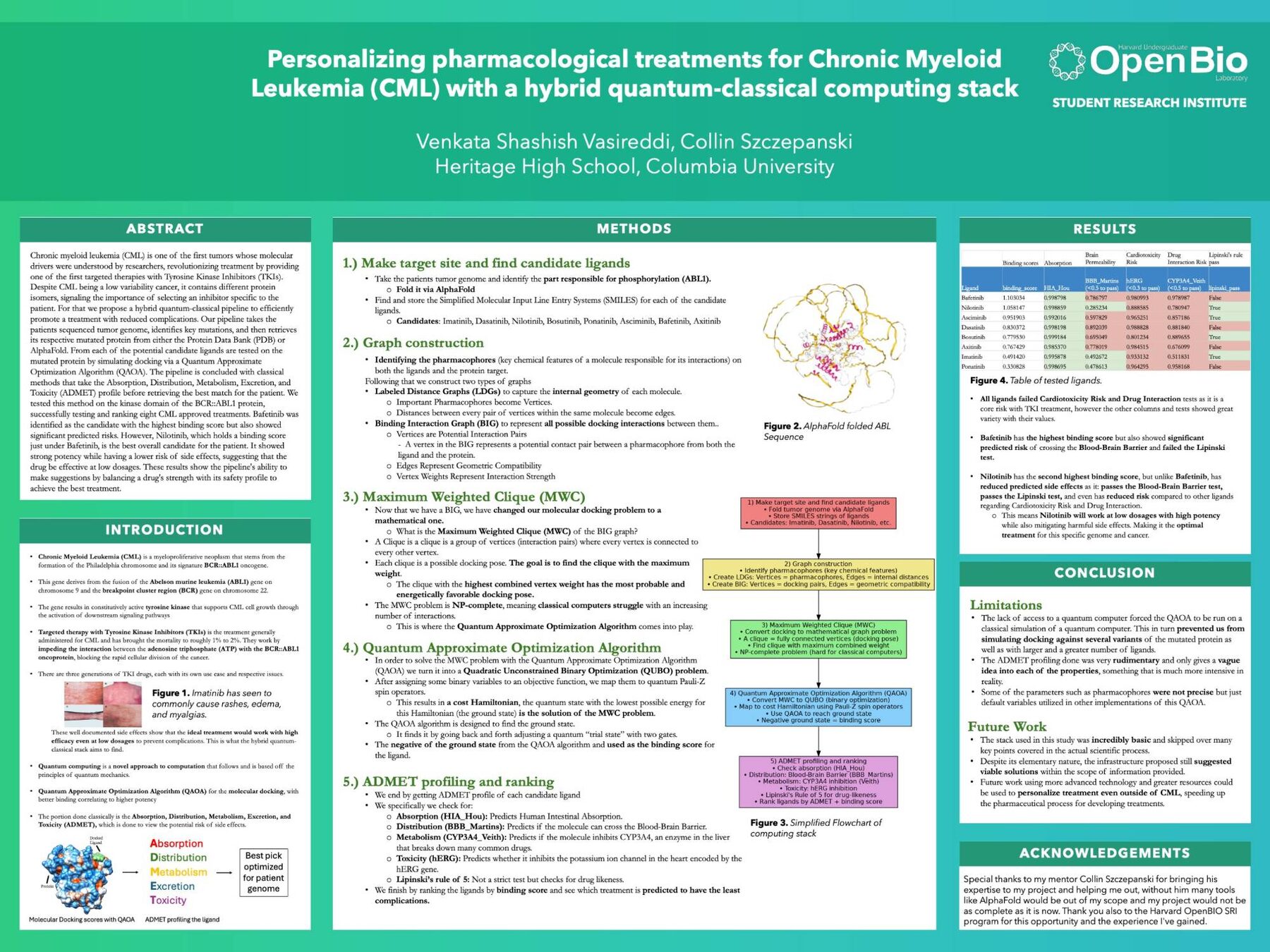
A glimpse of the work, mentored by Collin Szczepanski of Columbia University: quantum docking against the BCR::ABL1 target, classical safety profiling, and a test on eight approved drugs.
A look at the work
- Predicted the structure of the ABL1 kinase domain with AlphaFold2 and collected eight approved CML drugs as SMILES strings.
- Turned docking into a graph problem and solved it with the Quantum Approximate Optimization Algorithm (QAOA) to score how strongly each drug binds.
- Profiled each drug’s predicted safety and ranked them on binding score and safety together.
Stage 1: Quantum molecular docking
Uses the Quantum Approximate Optimization Algorithm (QAOA) to simulate how each drug interacts with the protein and calculate its binding strength.
- Takes a protein structure predicted with AlphaFold2 and each drug as a SMILES string.
- Finds the ABL1 ATP binding site in that structure automatically.
- Builds a Binding Interaction Graph between the drug and the protein around that site.
- Solves the Maximum Weighted Clique problem on the graph with QAOA, run on NVIDIA CUDA-Q, to get a binding score.
- Caps the graph at 15 nodes, one qubit each, to keep the circuit tractable.
Stage 2: Classical ADMET profiling
Uses deep learning (ADMET-AI) to predict the safety profile of each candidate, filtering for toxicity and absorption.
- Checks properties including blood-brain barrier penetration, intestinal absorption, and cardiotoxicity, along with Lipinski’s rule of five.
- Ranks the drugs on their safety profile together with their binding score.
Candidates and tools
Eight drugs, with SMILES strings from PubChem: Imatinib, Dasatinib, Nilotinib, Bosutinib, Ponatinib, Asciminib, Bafetinib, and Axitinib.
NVIDIA CUDA-Q, RDKit, Biopython, ADMET-AI, PyTorch, and AlphaFold2, run on Google Colab with a GPU runtime.
Results
- Bafetinib had the highest binding score (1.103) but was predicted to cross the blood-brain barrier and failed the Lipinski test.
- Nilotinib scored just under it (1.058), passed the blood-brain barrier and Lipinski tests, and had lower cardiotoxicity and drug interaction risk than the others, making it the best overall candidate.
- Every drug failed the cardiotoxicity and drug interaction tests, which is expected, as it is a core risk of TKI treatment.
Poster and certificate
Manuscript
Personalizing pharmacological treatments for Chronic Myeloid Leukemia (CML) with a hybrid quantum-classical computing stack
Chronic myeloid leukemia · QAOA · Molecular docking · ADMET · AlphaFold2
Questions about this work? shashish.v.vasireddi@gmail.com